
So you want to know more…
More about Tapping.
EFT (Emotional Freedom Technique) or 'Tapping' has roots in the 1970s when several doctors discovered that verbally focusing on a problem or issue (emotional or physical) – while manually stimulating acupuncture points – could bring surprising relief in their patients – particularly with regard to fears, phobias and physical responses to stress. One of them, patented by Dr. Roger Callahan, was called Thought Field Therapy. Later Gary Craig simplified the process and developed what is now known as EFT.
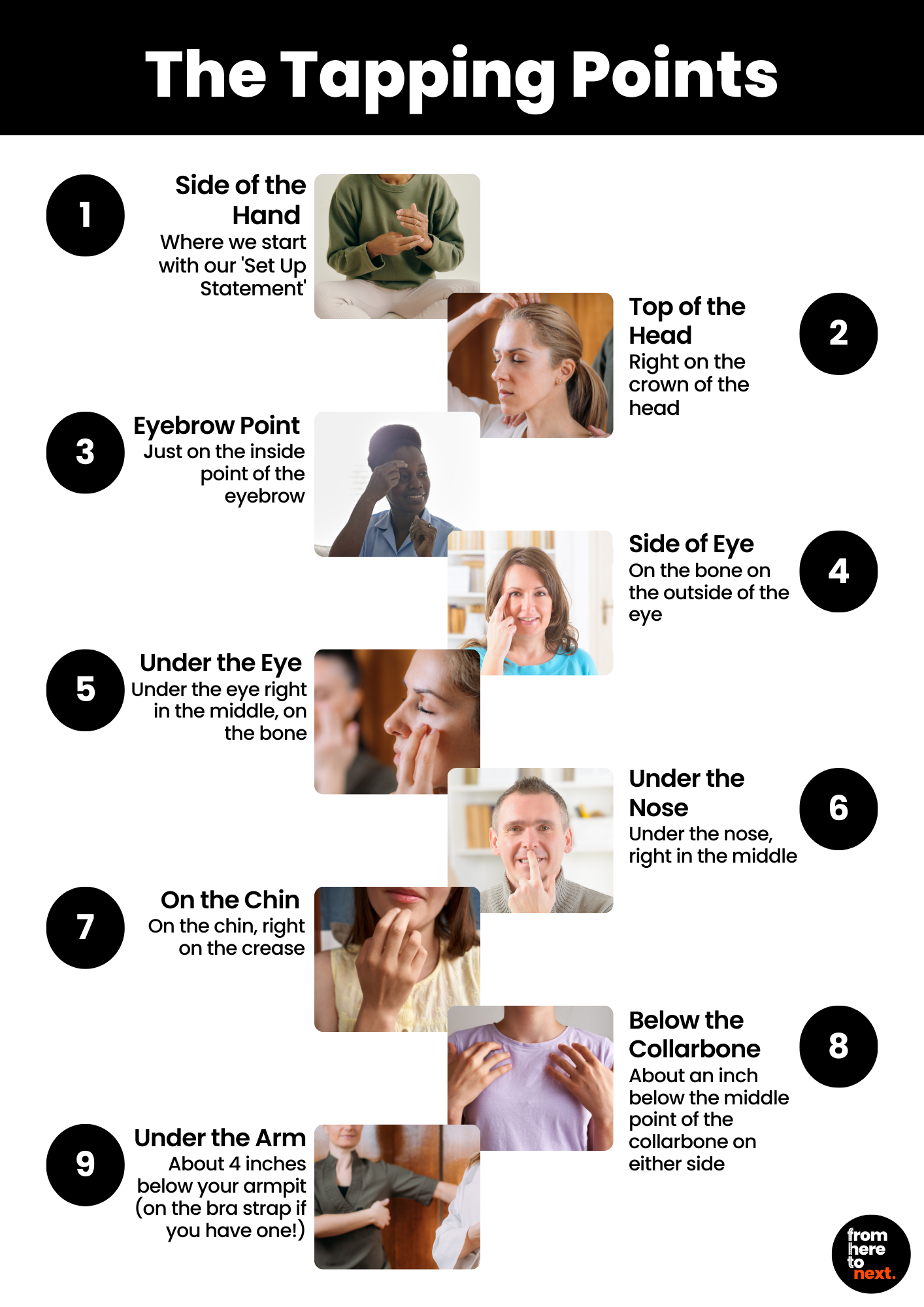
Simply put, we gently tap on 8 or 9 points on the head and torso that are known acupuncture points. We usually tap 5-10 times in each spot (see below for an image of the tapping points), so a ‘round’ of tapping takes a very short amount of time. The process of using tapping to clear a negative emotion may take several ‘rounds’ to bring the intensity of the feeling down and often another ‘aspect’ of the situation will come to us when our brain and body is feeling calmer. We may then choose to tap on that new aspect of the situation. Generally we feel some relief or improvement in the initial emotion after a few minutes of tapping, but for more sustained improvements, it is important to continue to tap on the underlying issues that are leading to the negative emotion.
Tapping works by sending calming signals to the brain (in particular the amygdala - our fight/flight/freeze centre), which allows us to ‘clear’ or release unpleasant emotions that are connected to events or experiences and have built up over time to support unhelpful thoughts or beliefs about ourselves. There have been numerous fMRI studies showing changed brain activity after using tapping to address a particular issue/craving/phobia etc.
This 10 minute video is a short summary of what tapping is, where it came from and how it works. It was delivered at a TEDx in Brisbane Australia by Dr Peta Stapleton, Australian clinical psychologist and researcher.
Research about EFT/Tapping
There is now a significant body of evidence based research showing excellent results for the outcomes of EFT and Energy Psychology. The following list is from the website of Dr Peta Stapleton PhD, citing some of the more recent studies:
As of 2020: 18 randomised control trials, 50+ randomised control trials, 50+ pre-post outcome studies, 50+ trials in non-English journals
2014–2016: 2 meta-analyses show energy psychology effective for depression and anxiety
2017: Meta-analysis shows EFT effective for PTSD
2019: Meta analysis shows tapping on the acupressure points is an active ingredient in the process (changes not due to the therapeutic relationship, other factors such as deep breathing etc)
2018-2019: Two studies on DNA changes after EFT First fMRI study on EFT published
2019: Blue Knot Foundation for (trauma) includes EFT in PTSD clinical guidelines in Australia
2020: EFT approved under the National Insurance Disability Scheme NDIS) for therapy in Australia 2020: Australian Psychological Society features EFT during National Psychology Week as emerging approach for pain
2020: APA journal (USA) published EFT cortisol replication study
2020: A major review of psychological treatments for PTSD – Energy psychology (combined somatic/cognitive therapies) was the 2nd most effective at reducing PTSD symptoms at the end of treatment to waitlist (after EMDR which was found to be most effective). Further, energy psychology had the greatest cost savings over no treatment, followed by EMDR, trauma-focused CBT and then other treatments
2021: APA approved EFT to be reviewed for trauma and PTSD and inclusion on the evidence based psychological treatments list (Dr Peta is leading this evaluation for the APA)
You can also find more research on the EFT International Website.
How do I Tap?
Tapping has a sequence that is largely followed by all practitioners. Sometimes people start a ‘round’ in different places, but generally all of the points in the image are covered in each ‘round’. Tapping on each of these points 5-10 times with 2-3 fingers is enough to send the calming signal to your brain.
If you are tapping to work through an issue, or lower a difficult emotion, you may need to do several rounds before you feel calmer.
The image shows you the position of the tapping points.
Click here to watch a video of how to tap.
More about Neuroplasticity.
Neuroplasticity is the principle that our brains, and the neural pathways within them, are mouldable - like plastic.
Think of learning to ride a bike... In the beginning we don't have the skill - that is, we don't have the neural connections (or pathways) that link one movement to another to create a smooth experience of riding. We wobble, we fall off, we can't coordinate the balance required to lift one foot off the ground as we pedal forward with the other. We fall... a lot!!
But as we practice, and repeat the effort of learning over and over again, we get better and better. In doing this, we are strengthening the connections in our brain. What was once a weak or non existent pathway in the brain becomes a well travelled road - like a super-highway. Before long, we don't even have to think about the movements that allow us to ride a bike, we just do it!
There is much research available now that shows that we retain this plasticity throughout our lives (and not just as children as it was once thought).
But why does it matter? How does this affect you?
You can tell I get excited about science and research, so if you’re not like me you might be asking why this is important in helping us get unstuck…
Well the bottom line is I want you to know how much influence you have over your brain and the patterns you have… and the answer is a lot!
It is still hard work, but you are not without choice. If you are brave and prepared to persist, you can make big changes that could give you the life you seek.
Research about Neuroplasticity
Our understanding or Neuroplasticity is growing constantly and the list of research is large. Below are some well known books and researchers who study our brains and the concept of Neuroplasticity.
Books
Norman Doidge: The Brain that Changes Itself.
Norman Doidge: The Brain’s Way of Healing.
Bessel van der Kolk: The Body Keeps the Score.
Dr Dan Siegel: Mindsight
Websites & Podcasts
Norman Doidge: https://www.normandoidge.com
Bessel van Der Kolk: https://www.besselvanderkolk.com
Dr Dan Siegel: https://drdansiegel.com
The Huberman Lab (Dr Andrew Huberman): https://www.hubermanlab.com